BugCanary
The offensive-security practice we run ourselves.
- client engagements and bug bounty programs
- 9
- critical and high vulnerabilities found
- 25+
- records found exposed and reported
- 10k+
- of findings shipped with a working proof of concept
- 100%
The problem
Most teams learn how their auth really behaves after someone else finds out first. Scanners report the obvious and miss the logic flaws that actually cost you.
What we built
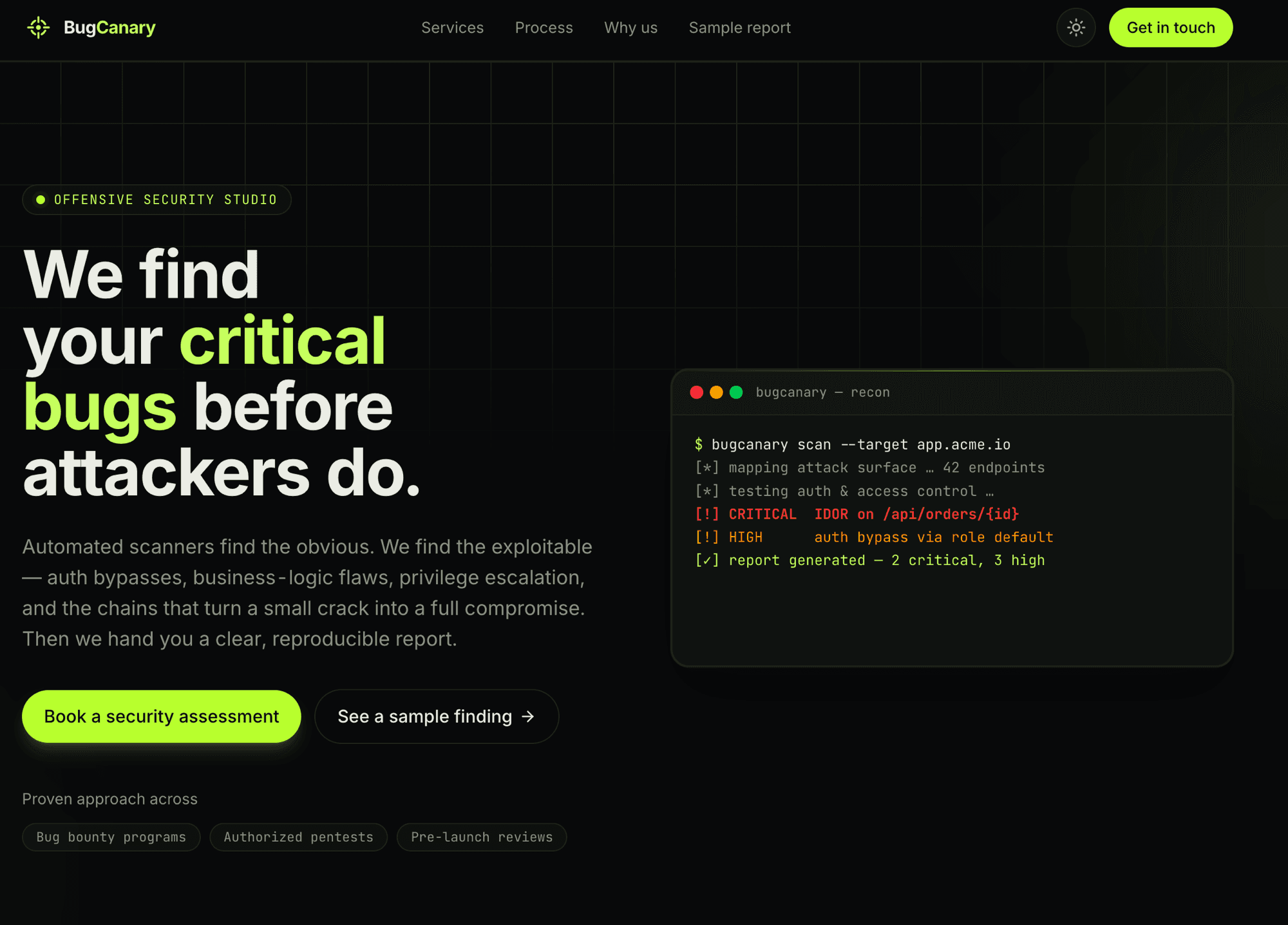
BugCanary: manual penetration testing, bug bounty work and pre-launch reviews. It is why security is not a phase at the end of a PeakStack build. The people who break software for a living are the people writing yours.
What it does
- Manual testing for auth bypasses, business-logic flaws and privilege escalation
- Every finding shipped with a reproduction, not a severity guess
- Pre-launch reviews before a product meets real users
- The same threat model applied to everything we build
Built with: Manual pentesting · Bug bounty · Pre-launch review
A scanner tells you what is old. A person tells you what is broken.
We run automated tooling too, on every push. It is necessary and it is not enough. These are the classes of flaw we test by hand, because they only exist in the gap between what your code does and what your business means.
Auth bypass
A token that still works after the session was supposed to end.
Broken access control
An object id that answers to an account it does not belong to.
Business-logic flaws
The discount that applies twice if you go back a step.
Privilege escalation
A support role that can reach an admin-only route.
Tenant isolation failures
One customer's rows arriving in another customer's export.
Security decisions, taken in the order that makes them cheap.
Each of these is a gate in a PeakStack build, not a document produced at the end for somebody's file.
Threat-modelled before it is built
Any feature that touches authentication, money or customer data gets written down first: who would want it, how they would try to get it, and what stops them.
Designed at the schema, not patched at the controller
Auth, sessions, access control and tenant isolation are decided in the data model, where the rule is enforced once for every query.
Dependencies and secrets scanned in CI
A known-vulnerable package or a key pasted into a commit fails the build on the push that introduced it.
Attacked before your users arrive
Before real people and real money touch it, the product gets the same manual testing BugCanary runs against other companies' systems.
We build to OWASP ASVS, the Application Security Verification Standard, so your own security team can hold us to a written level rather than to our adjectives. It is not a certification we hold, and we will not pretend otherwise. Nobody can sell you a product that will never be breached: what this buys is that the cheap attacks stop working, the expensive ones get loud, and the person who finds the next flaw is on your side of the invoice.

Want one built like this?
Tell us what you're building. You get a written scope and a fixed price for the first milestone.
Book a 20-min call